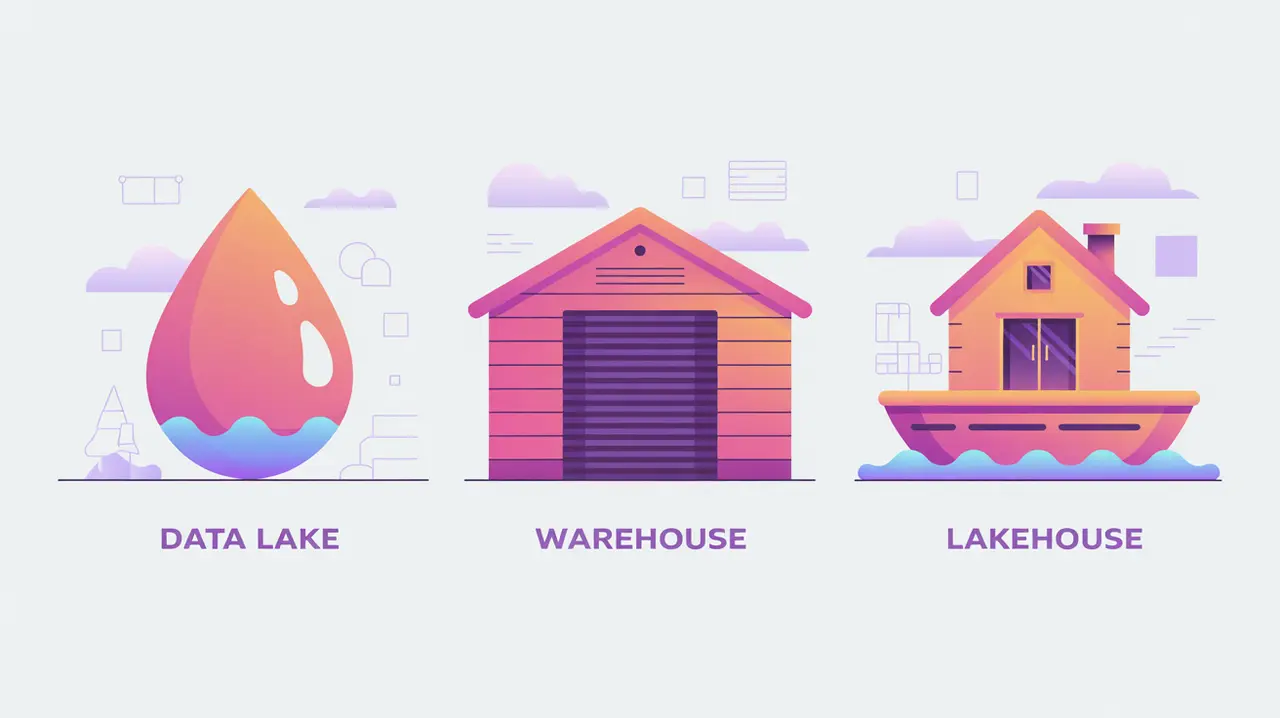
Importance of Data Lake, Warehouse, Lakehouse
Data lakes, data warehouses, and data lakehouses are three approaches to storing and managing organizational data. Their importance today lies in the explosion of digital information and the need to balance flexibility with performance. Each architecture offers different strengths: data lakes handle raw, unstructured data; warehouses support structured, high-performance analytics; and lakehouses aim to combine the best of both. Choosing among them is a strategic decision that shapes how organizations can harness AI and analytics.
For social innovation and international development, these architectures matter because many organizations deal with fragmented, multi-format data, from surveys and reports to satellite images and financial records. Selecting the right storage and processing system determines whether they can generate reliable insights in ways that are scalable, affordable, and inclusive.
Definition and Key Features
A data lake is a storage repository that holds raw data in its native format, whether structured, semi-structured, or unstructured. This flexibility makes it cost-effective and useful for experimentation but can lead to “data swamps” if governance is weak. A data warehouse, by contrast, stores structured and cleaned data optimized for querying and analytics, supporting reliable reporting but limiting flexibility.
A data lakehouse is a newer hybrid approach that combines the scalability and flexibility of data lakes with the reliability and performance of data warehouses. By allowing both raw and structured data to coexist, lakehouses support machine learning workflows and business intelligence simultaneously. They are not simply larger storage systems but integrated environments designed for modern AI and analytics.
How this Works in Practice
In practice, organizations choose among lakes, warehouses, and lakehouses based on their needs. Data lakes are best for storing diverse sources such as log files, videos, or social media data. Warehouses excel at generating dashboards, compliance reports, or other structured analyses. Lakehouses enable teams to run advanced AI models on raw data while also producing traditional reports.
Key challenges include governance, cost management, and skill requirements. Poorly managed data lakes can become unusable, while warehouses can be too rigid for dynamic datasets. Lakehouses promise balance but often require advanced tools and expertise. Success depends not just on the technology but on aligning the architecture with organizational capacity and mission.
Implications for Social Innovators
For mission-driven organizations, these architectures unlock different pathways for impact. Health systems may use data warehouses for structured patient reporting, while storing diagnostic images in data lakes for AI analysis. Education platforms can adopt lakehouses to integrate structured exam data with unstructured classroom observations. Humanitarian agencies rely on lakes to capture diverse crisis data streams, later refining them into structured warehouses for donor reporting.
By choosing the right architecture, organizations can ensure that data storage is not just a technical necessity but a strategic asset for advancing social good.