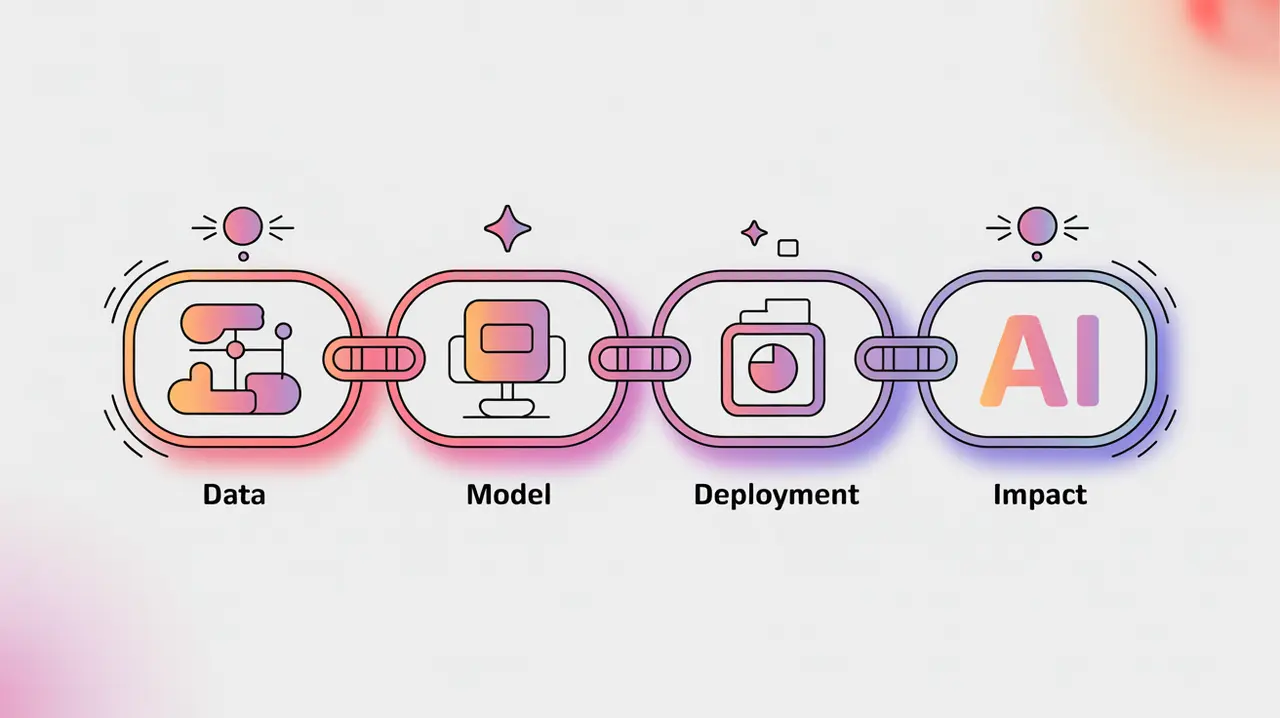
Importance of AI Value Chain
The AI Value Chain describes the sequence of activities, resources, and stakeholders involved in creating, deploying, and maintaining artificial intelligence systems. It spans everything from data acquisition to model development, infrastructure provisioning, and downstream application in real-world contexts. Its importance today lies in the need to understand AI not as a single breakthrough but as an interconnected ecosystem, where value is added or lost at each step.
For social innovation and international development, mapping the AI Value Chain matters because it highlights the dependencies and opportunities across data, models, hardware, and governance. By understanding where bottlenecks exist, mission-driven organizations can design interventions that strengthen resilience, improve inclusion, and ensure equitable access to AI benefits.
Definition and Key Features
The AI Value Chain typically begins with raw data and moves through stages such as collection, labeling, storage, model training, deployment, and monitoring. Each stage relies on specialized actors, from data providers and labeling platforms to chipmakers, cloud service providers, and model developers. Value is added at each link. However, vulnerabilities such as bias in data or concentration of hardware supply can also accumulate.
It is not the same as a simple production pipeline, which implies linearity and one-way flow. AI value chains are dynamic and iterative, with feedback loops where models generate new data or where deployment insights feed back into training. This makes the AI Value Chain more adaptive and complex than many traditional industries.
How this Works in Practice
In practice, mapping the AI Value Chain helps organizations identify leverage points. For example, a government might focus on strengthening local data ecosystems, while startups invest in model innovation or infrastructure efficiency. Civil society groups may prioritize governance and oversight, ensuring transparency at each stage. Understanding dependencies also reveals risks, such as reliance on a small number of chip foundries or proprietary model providers.
Challenges include the opacity of global AI supply networks, concentration of control in a few large actors, and uneven distribution of resources across geographies. Effective navigation of the AI Value Chain requires partnerships, open standards, and strategies that address both technical and ethical dimensions.
Implications for Social Innovators
The AI Value Chain directly shapes outcomes in mission-driven work. Health organizations depend on reliable data collection and model training to deliver accurate diagnostic tools. Education initiatives rely on equitable access to infrastructure and cloud services to scale adaptive learning platforms. Humanitarian agencies must assess the entire chain, from data provenance to model governance. This can ensure that AI systems deployed in crises are trustworthy, secure, and responsive.
By analyzing and engaging with the AI Value Chain, organizations can identify opportunities to localize value, reduce risk, and design interventions that make AI more inclusive and impactful.