Importance of Theory of Change in the AI Era
A Theory of Change (ToC) in the AI Era is a structured framework that articulates how AI-enabled interventions are expected to create social impact, connecting activities to outputs, outcomes, and long-term change. It updates traditional ToC models by accounting for both the opportunities and risks introduced by AI technologies. Its importance today lies in ensuring that the adoption of AI is intentional, evidence-based, and aligned with mission goals, rather than driven by hype.
For social innovation and international development, ToC in the AI era matters because organizations must demonstrate not just that AI can be deployed, but that it advances equity, inclusion, and lasting social benefit.
Definition and Key Features
The ToC approach has long been used in development and philanthropy to link inputs and activities to desired social outcomes. In the AI era, the framework expands to include considerations such as algorithmic bias, data governance, human-AI collaboration, and unintended consequences. It explicitly integrates assumptions about technology, community context, and capacity building.
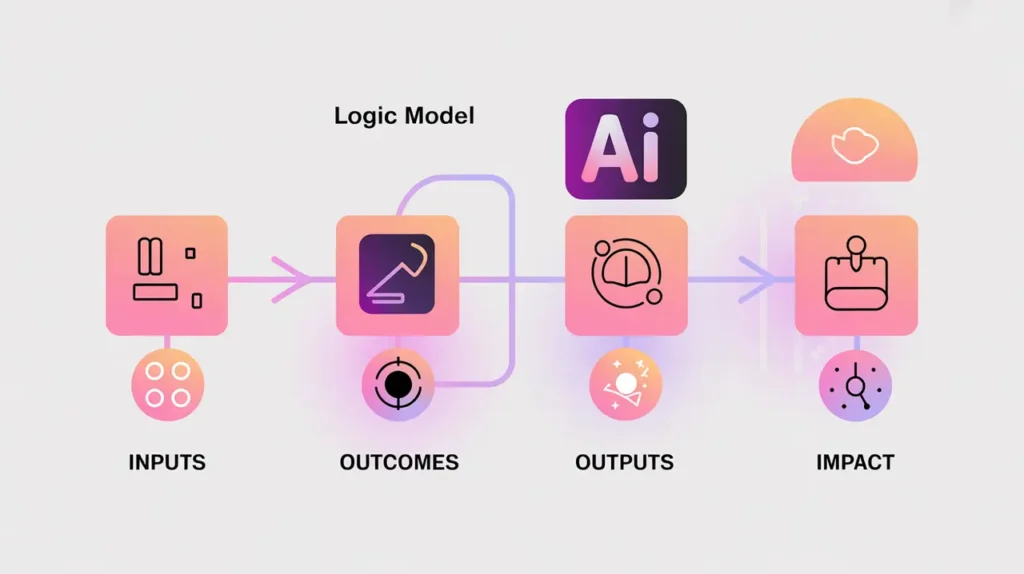
It is not the same as logic models, which map inputs and outputs more narrowly. Nor is it equivalent to innovation strategies that emphasize experimentation without connecting to long-term outcomes. ToC provides a holistic framework for aligning AI adoption with mission-driven change.
How this Works in Practice
In practice, a nonprofit might develop a ToC for an AI-driven education platform that outlines how improved personalization leads to better student outcomes, while also stating assumptions about teacher adoption and digital access. A health NGO might design a ToC showing how diagnostic AI contributes to earlier detection of disease, but also includes safeguards to ensure equity across populations. ToC frameworks often incorporate iterative learning, recognizing that AI impacts evolve as systems are deployed.
Challenges include difficulty in predicting AI’s long-term effects, complexity in mapping indirect outcomes, and the need for cross-disciplinary expertise. Without integrating ethical and governance considerations, ToCs risk oversimplifying the transformative but uncertain nature of AI.
Implications for Social Innovators
A ToC in the AI era strengthens alignment across mission-driven sectors. Health programs can clarify how AI contributes to better health outcomes while ensuring inclusivity and patient safety. Education initiatives can connect adaptive learning technologies to equity and achievement goals. Humanitarian agencies can show how AI-enabled logistics and targeting improve aid delivery while protecting vulnerable groups. Civil society groups can use ToCs to evaluate whether AI adoption truly advances justice and rights.
By reimagining the Theory of Change for the AI era, organizations create intentional, transparent pathways that ensure technology serves people and mission, not the other way around.