Importance of Supervised Learning
Supervised Learning is one of the most widely used approaches within Machine Learning, and its importance today comes from its balance of practicality and effectiveness. It underlies many systems people interact with daily, such as email spam filters, product recommendations, and speech recognition tools. What makes it especially relevant now is that it allows organizations to apply data they already have to create predictive models with immediate impact.
For social innovation and international development, Supervised Learning offers a pathway to develop targeted solutions for communities navigating scarcity. By training models on labeled examples, organizations can build tools that classify, predict, or diagnose in ways that scale human expertise. Its straightforward approach makes it one of the most accessible forms of machine learning for mission-driven teams seeking to bring intelligence into their work.
Definition and Key Features
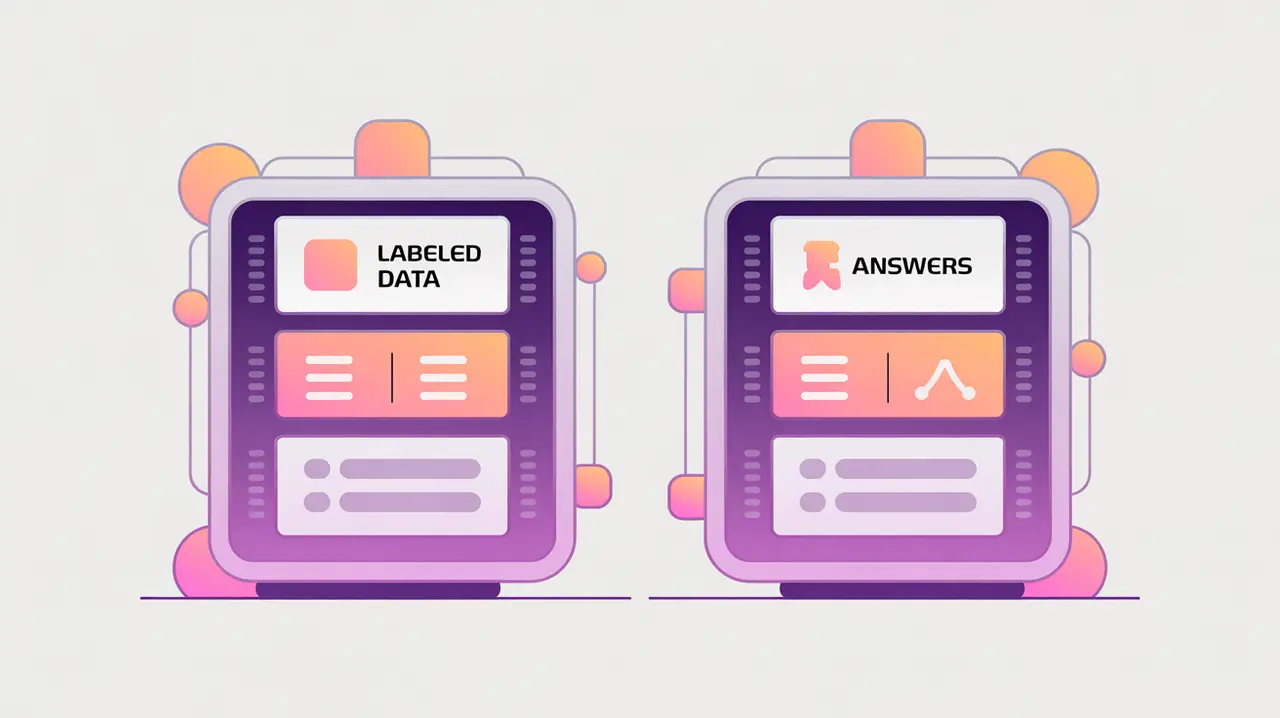
Supervised Learning refers to the process of training a model on a dataset where each example is paired with the correct answer, or label. The system learns by comparing its predictions against these labels and adjusting until it achieves an acceptable level of accuracy. Arthur Samuel’s work on computer checkers in the 1950s is often cited as an early demonstration of this approach, though it has since grown into one of the most powerful paradigms in machine learning.
It is not the same as unsupervised learning, which identifies patterns in unlabeled data, nor is it equivalent to reinforcement learning, which learns through feedback and rewards. Instead, Supervised Learning thrives when there is sufficient labeled data and a clear target outcome. Common applications include classification, such as determining whether an email is spam or not, and regression, such as predicting the price of a crop based on historical data.
How this Works in Practice
In practice, Supervised Learning involves splitting a dataset into training and testing sets. The model is trained on the labeled training set, learning relationships between features and outcomes. It is then evaluated on the testing set to measure how well it generalizes to new, unseen data. Algorithms commonly used include logistic regression, decision trees, random forests, and support vector machines.
The performance of supervised models depends heavily on the quality of the labeled data. If labels are inconsistent, biased, or incomplete, the model’s predictions will reflect those weaknesses. While these models can be highly accurate, they are limited by the range of examples they are exposed to during training. This makes continual retraining and monitoring necessary to maintain reliability, especially in fast-changing environments.
Implications for Social Innovators
Supervised Learning is already shaping program delivery in social innovation and development. Health organizations use supervised models trained on thousands of medical images to detect diseases such as pneumonia or cervical cancer in clinics with few specialists. Education programs employ supervised systems to grade short-answer questions, freeing teachers to focus on personalized support for students.
In agriculture, supervised models predict crop yields by combining weather data, soil measurements, and historical harvest records. Financial service providers use supervised approaches for credit scoring in communities without traditional banking histories, expanding access to loans and savings products. These examples illustrate how labeled data can be transformed into actionable insights. The key challenge for mission-driven organizations is ensuring that the labels used to train these systems are contextually accurate and representative of the populations served. Done well, supervised learning can provide practical, transparent tools that extend expertise into underserved areas.