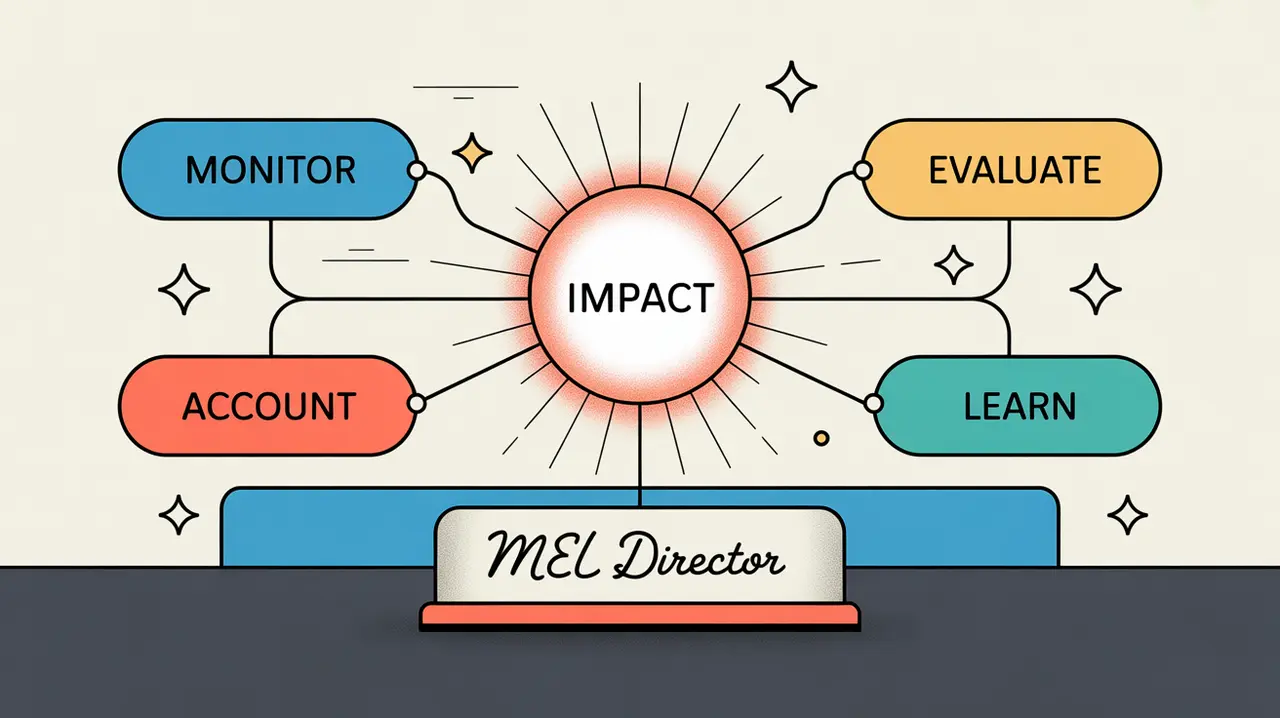
What Does the MEL Director Role Involve?
A MEL (Monitoring, Evaluation, and Learning) director is responsible for setting the strategic vision and overseeing the design and implementation of the organization’s MEL systems. This includes developing MEL frameworks, ensuring the quality and use of data, leading evaluations, guiding learning agendas, and aligning evidence efforts with organizational strategy. The role typically sits within executive, strategy, or research functions. In nonprofits and social enterprises, MEL directors play a critical role in ensuring that programs are evidence-driven, adaptive, and accountable to stakeholders, funders, and the communities they serve.
At What Level does this Role Operate?
Executive Level: This role typically reports to the chief impact officer, executive director, or head of strategy. It involves leadership of MEL teams and functions, strategic oversight of evidence systems, and advisory responsibilities to senior leadership and boards.
Relative Employability: MEL director roles are in growing demand across nonprofits, social enterprises, development agencies, and international NGOs. As organizations place greater emphasis on impact measurement and learning, experienced MEL leaders are highly sought after to shape organizational strategy and meet funder expectations.
Relative Pay Scale: MEL director roles sit within executive-level pay bands, reflecting their strategic responsibilities, leadership scope, and influence on organizational direction.
What are the Key Responsibilities and Activities?
- Develop and implement organizational MEL strategies and frameworks aligned with strategic goals and funder requirements
- Provide leadership to MEL teams, ensuring effective coordination, quality assurance, and capacity development across functions
- Oversee the design and execution of evaluations, assessments, and learning initiatives to generate actionable evidence
- Guide the integration of MEL systems with program design, strategic planning, and decision-making processes
- Ensure data quality, ethical standards, and methodological rigor in all MEL activities
- Facilitate organizational learning by translating data and findings into insights that inform program improvement and strategic shifts
- Build and maintain relationships with funders, research partners, and other stakeholders to strengthen MEL practices and resources
- Represent the organization externally in learning networks, conferences, and collaborative initiatives
What Core Competencies and Qualifications are Needed?
Required Qualifications and Experience
The following reflect common qualifications and experience expected for this role, while recognizing that pathways may vary by context, organization, and region.
- Advanced academic background in social sciences, statistics, public policy, economics, development studies, or related fields, or equivalent professional experience
- Extensive experience in MEL leadership, including designing and overseeing complex evidence systems
- Proven expertise in evaluation methodologies, data analysis, and learning facilitation
- Demonstrated ability to lead teams, manage budgets, and build organizational MEL capacity
- Strong strategic thinking, communication, and stakeholder engagement skills
- Familiarity with funder expectations, reporting requirements, and international MEL standards
Key Competencies
- Strategic MEL system design and leadership
- Evaluation oversight and methodological expertise
- Organizational learning and evidence use
- Data quality assurance and ethical standards
- Team leadership and capacity building
- Stakeholder engagement and funder relations
- Strategic advisory and representation
How are AI and Automation Shaping this Role?
An AI-native MEL director will look to AI and automation to strengthen evidence systems, improve data quality, and generate insights at scale. They can use AI tools to integrate diverse data sources, apply advanced analytics, and model impact scenarios to inform strategy. Automation can streamline data collection, indicator tracking, and reporting across programs, freeing up capacity for strategic analysis and learning. By integrating these tools, MEL directors can lead more adaptive, data-informed organizations that continuously improve their impact.
What Career Pathways and Transferable Skills are Associated with this Role?
MEL director roles can lead to positions such as chief impact officer, head of strategy, or executive director. The skills developed in strategic evidence leadership, evaluation, learning facilitation, and stakeholder engagement are highly transferable across nonprofits, social enterprises, development agencies, research institutions, and philanthropic organizations. This role represents a senior leadership position that shapes how organizations understand, demonstrate, and strengthen their impact.